

Your story isn’t only what you say.

Your Competitor Isn't Winning on Product
Most of the individuals and organizations we work with don't lose deals on price, features, or tenure.
They lose on mindshare; someone else telling a more compelling story that captures the attention of the customer, the partner, or the voter.
Features and benefits don’t protect you from a competitor who's providing value on a different level.
Your audience won’t accept your non-fiction if you don’t own your fiction.

Mindshare Compounds
New entrants don't compete on product first. They compete on attention.
Most organizations start addressing a gap by respond by building features nobody asked for instead of building the story and distribution that make the story so clear you have to tell it.
Mindshare capture is not a one-time campaign.
It's a strategy that either scales over time or erodes while a hungrier competitor tells a better story to the same audience.

Stories as Infrastructure, Not Decoration
A narrative isn't a tagline, a rebrand, or a slide with new fonts.
It's the system, feedback loops, and relationships underneath how your team pitches without you in the room, how your partners describe you when they're recommending you, and how your customers explain why they picked you versus alternatives.
When that system is inconsistent, every other investment works against itself:
sales enablement contradicts marketing,
marketing contradicts what partners actually say
the story fragments exactly where it needs to hold together.
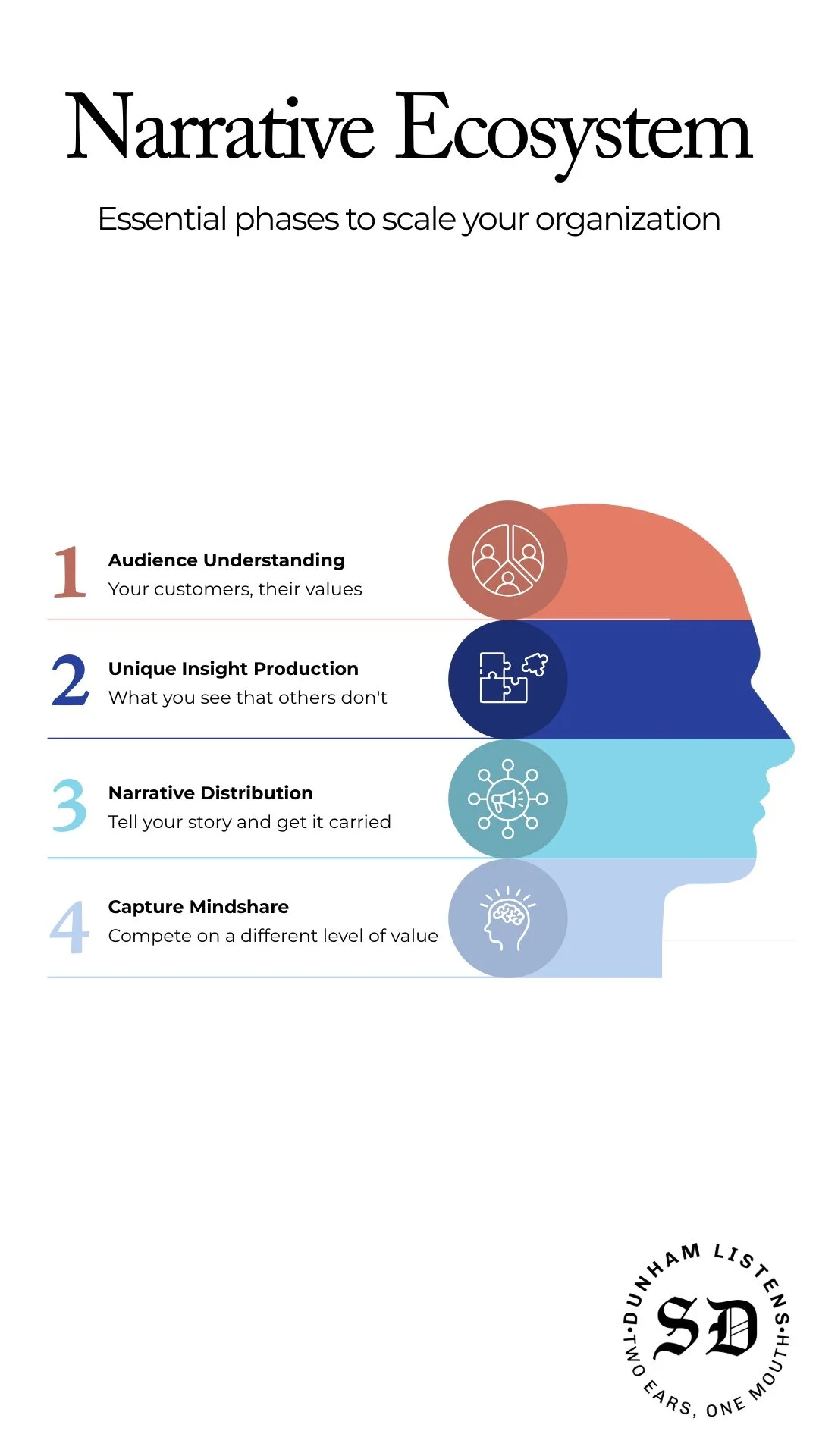
The Work Isn't Finished at Launch
Every narrative has a shelf life.
Markets shift, competitors reposition, and a story that you told last month can go stale without anyone noticing until pipeline slows down.
Part of the engagement is building the review cadence that catches drift before it costs you deals.
The other part is the built-out production and distribution systems that keep the engine running, not a one-and-done deliverable that sits in a slide deck.