

Conflict can be transformative.
Don't Think About a Pink Elephant
That's how conflict works.
Avoidance doesn’t make it go away, it just changes where it shows up: in turnover, in slow decisions, in deals that stall.
Avoidance isn't neutral. It's a cost.
Unaddressed or dysfunctional conflict drains teams and creates an environment of discontent, mistrust, and lack of collaboration.

Conflict Isn’t Failure
Healthy teams and healthy partnerships don't have less conflict than dysfunctional ones.
They have better ways of handling it.
Conflict often means a need is going unaddressed. Treated as a personality problem, it gets managed with platitudes and implies that some team members are less important than others.
Treated as a systems problem, conflict is a data point that unveils a misalignment in incentives, expectations, or communication.
Instead of slowing things down, it becomes the fastest diagnostic tool available for finding out what's actually broken.

Incentives Precede Trust
The instinct is to try to build trust with more check-ins, more team off-sites, more "let's just communicate better."
The more durable fix is redesigning the incentive structure underneath the relationship so the behavior that builds trust becomes the behavior that's actually rewarded.
As they say: You get what you pay for.
People appreciate knowing what they’re paid for and measured on. Get the incentives right, and the trust follows as a natural consequence.

How the Engagement Works
We’re usually called in mid-crisis: an ongoing conflict that's already costing time, money, or relationships.
Instead of smoothing it over for the sake of a quiet room, we tackle it directly.
We only take on organizations where leaders are ready to start with themselves. This approach only works if the people at the top are willing to change first.
Every situation is different, but the patterns repeat. Depending on what you're facing, the engagement often runs one of three ways:
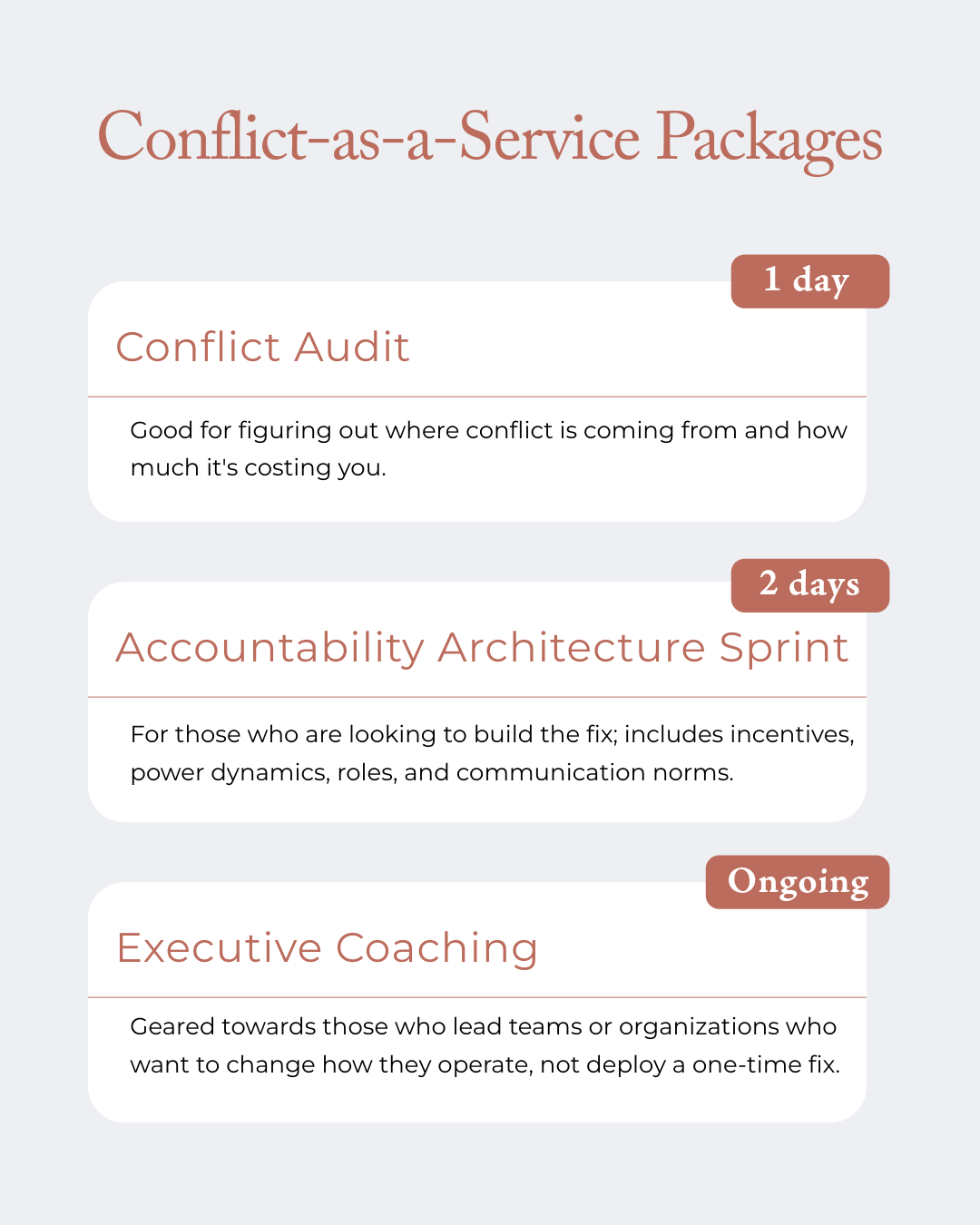
Who this is for?
Leadership teams, partner organizations, and founders who are done treating conflict as a personality problem instead of a systems issue.
Those who'd rather resolve the underlying pattern than manage the same conflict a third time next month.
FAQs
Is this mediation?
1
Mediation resolves a specific dispute. CaaS does that, then builds the infrastructure so the same category of conflict doesn't recur.
Do you work with the whole team or just leadership?
2
We work with all stakeholders relevant to the conflict. Most engagements involve individual contributors and management roles across teams and title seniority.
How fast can you start?
3
The Conflict Audit can typically be scheduled within two weeks of an initial conversation. If your need is more urgent, let’s have a conversation to see if we can meet your need or if we can refer you to someone with immediate capacity.